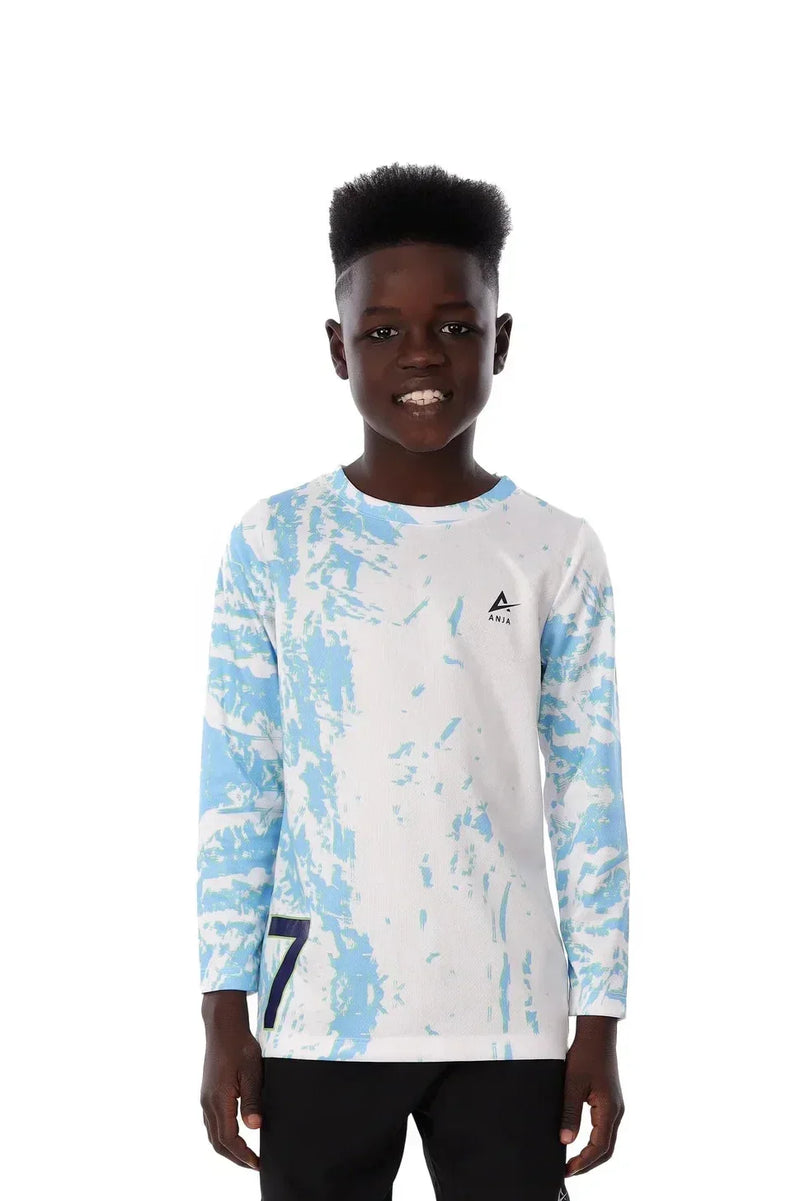
Swimwear is the one piece of kids' sportswear that gets destroyed on a schedule. A cotton T-shirt worn twice a week survives a full year. A swimsuit worn in a chlorinated club pool three times a week starts sagging at the seat and going thin across the back in eight to ten weeks if the fabric is wrong. Parents in Cairo usually buy a replacement by mid-season and assume they got a bad batch. Usually they did not. They bought a beach fabric and sent it into a training pool.
This guide is about the two decisions that actually determine how long a kids' swimsuit lasts and how much your child will tolerate wearing it: the fabric, and the fit when the suit is wet. Everything else, including the print, is secondary. If you want to see the full range while you read, the kids' swimwear collection is organised by type rather than by colour, which makes this easier to follow.
Why Chlorine and Sunscreen Destroy Kids' Swimwear Before It Wears Out
Almost no kids' swimsuit dies from abrasion. It dies chemically. Chlorine attacks elastane, the stretch fibre, and once elastane goes brittle the suit loses its recovery. It still stretches, but it no longer snaps back, so it bags at the seat and gapes at the armhole. Salt water is gentler but dries the fibres out and leaves crystals in the seams that saw at the thread. Sunscreen, especially the thick mineral kind sold for children, leaves oils that bond to the fabric and yellow it permanently around the neckline.
The practical consequence: a suit's life is measured in exposures, not in months. A suit used once a fortnight at a North Coast chalet can last three summers. The identical suit in a club pool four sessions a week is finished in one term. Buy the fabric that matches the exposure, not the price tag.
Reading the Care Label Before the Price Tag
Turn the suit inside out and find the composition. Anything with 18 per cent elastane or more is a beach or leisure suit; it will feel beautiful and fail fast in chlorine. Look for polyester-dominant blends or an explicit chlorine-resistant claim for pool use. If the label only says "polyamide/elastane" with no chlorine note, treat it as a beach suit no matter what the shop assistant says.
Polyester, PBT and Nylon-Elastane: Choosing Kids' Swimsuit Fabric by Where They Swim
There are really only three fabric families in the kids' market in Egypt, and they behave very differently.
| Fabric | Best for | Chlorine life | Feel and fit | Drying time |
|---|---|---|---|---|
| Polyester (often with PBT) | Club pool training, school swimming lessons | Longest — a full season of heavy use | Firmer, holds shape, less "hugging" | Fast |
| Nylon-elastane (polyamide blend) | Beach, chalet pool, holiday swimming | Short under daily chlorine | Softest, most flattering stretch | Medium |
| Chlorine-resistant blend | Everything, if the budget allows one suit only | Long | Between the two | Fast |
Polyester and PBT for Club Pool Training
If your child swims at a club — Gezira, Heliopolis, Wadi Degla, a compound pool with a coach — polyester is the correct answer and it is not a compromise. It feels stiffer in the hand, which puts parents off in the shop, but on a swimming child that firmness is what stops the leg opening from rolling. Competitive swim training is exactly where the soft, luxurious fabric collapses first.
Nylon-Elastane for Beach and Occasional Swimming
For a Red Sea week in Hurghada or Marsa Alam, or a handful of weekends at a North Coast pool, nylon-elastane is comfortable and worth it. Salt water does not punish elastane the way chlorine does. This is also the family that holds bright prints best, which matters more to a six-year-old than any argument about fibre chemistry.
Lining, Double Layers and the See-Through Problem
Ask about the lining separately from the shell. A single-layer suit in a light colour becomes transparent when wet, and a child who notices that will refuse to wear it again. Front-lined is the minimum for girls' suits; fully lined is better. The girls' sleeveless one-piece with front zip is a useful reference point for what a properly lined training suit looks and feels like.
Kids' Swimwear Sizing: The Suit That Fits Dry and Slips When Wet
This is the failure nobody warns you about. Swim fabric gains a small amount of length when saturated and loses a lot of grip. A suit that is merely "fine" in the fitting room becomes a suit that creeps down at the shoulder and rides up at the leg after ten minutes in the water. Children then spend the lesson pulling at it instead of swimming.
The rule is simple: a kids' swimsuit should feel slightly snug and slightly short on the torso when dry. Not tight across the chest, not digging into the shoulder, but definitely not relaxed. If it feels perfectly comfortable dry, it is one size too big for wet.
Measuring Chest, Torso Length and Hip
Three measurements decide a one-piece, and torso length is the one everyone skips. Run the tape from the top of the shoulder, down the front through the crotch, and back up to the same shoulder point. Two children with identical chest measurements can differ by six centimetres here, and that difference is the whole reason one of them complains the suit digs into the shoulder. Our kids' sportswear size guide by age covers how to take these measurements without a struggle.
Age Labels Versus Real Egyptian Sizing
Age labels on swimwear are the least reliable in the whole children's market, because swim patterns are cut close and a 5 per cent difference shows immediately. Egyptian-made swimwear tends to run true to chest measurement; imported fast-fashion swimwear often runs one size small through the torso. Always buy to the measurement, and if your child sits between two sizes for a training suit, take the smaller one — the larger will leak water and drag.
The Two Fitting-Room Tests That Predict Wet Behaviour
- Shoulder test: slide two fingers under the strap and pull straight up. If you can lift the strap more than about three centimetres off the shoulder, the torso is too long.
- Squat test: ask your child to squat fully and then raise both arms overhead. The leg opening should not roll and the seat should not pull down at the back.
- Armhole test: with arms down, the armhole should not gape open enough to see the ribcage.
- Zip test: on a front-zip suit, the zip should still lie flat when the arms are stretched forward in a swimming position.
One-Piece Swimsuits, Swim Shorts and Long-Sleeve Swimwear by Age
The right shape changes as the swimming changes, not simply as the child grows.
Girls' One-Piece Swimsuits from Four to Fourteen
A one-piece is the only sensible shape for lessons and training. Two-piece sets for young girls fail the moment there is a dive or a push off the wall. Between roughly four and eight, a sleeveless one-piece is the simplest thing to get on and off in a crowded changing room. From nine or ten, many girls start asking for more coverage, at which point a short-sleeve one-piece with a front zip solves both problems: more skin covered, and a zip so she can dress herself. The full range sits in the swimming collection.
Boys' Swim Shorts and One-Piece Swimsuits
For beach and casual pool time, boys' swim shorts are the default and the drawstring matters more than the print — a waistband that will not hold is the single most common complaint. For actual training, a one-piece swimsuit cuts drag and does not fill with water on a dive, which is why club coaches keep asking for it.
Long-Sleeve Swimwear and Sun Protection
Between May and September, midday sun on the North Coast or in the Red Sea burns a child's shoulders in twenty minutes, and no sunscreen survives repeated dunking. A long-sleeve one-piece swimsuit removes the problem from the two areas that burn worst, the shoulders and the upper back, and it means far less reapplying. For families who want full coverage for other reasons as well, our kids' burkini guide deals with that separately.
School Swimming, Club Training and Beach Season: Three Different Purchases
Parents often try to buy one suit for all three. It rarely works, and the reason is exposure.
| Use case | Frequency | Buy this fabric | How many suits | Replace after |
|---|---|---|---|---|
| School swimming lesson | Once a week, one term | Polyester or chlorine-resistant | One, plus a spare if drying is slow | Usually one school year |
| Club training | Three to five times a week | Polyester / PBT only | Two, rotated | One season per suit |
| Beach and chalet | Weekends, summer only | Nylon-elastane | Two, for drying time | Two or three summers |
Two suits rotated is not an upsell, it is the cheapest way to own swimwear. A suit that goes back into the bag damp and gets worn again the next morning ages roughly twice as fast as one that gets a full day to dry flat.
Club Pool Chlorine Levels in Cairo
Indoor club pools in Cairo tend to run chlorine harder than hotel pools, particularly in winter when ventilation is poor and the water is used constantly. If your child trains indoors through the winter, treat fabric choice as non-negotiable and rinse the suit at the pool rather than waiting to get home.
Packing the Swim Bag: Robe, Towel and Wet-Kit Separation
The swim bag causes more ruined swimwear than the pool does. A wet suit rolled inside a towel inside a closed backpack for six hours is a chemistry experiment. What actually helps is a bag with a compartment you can wipe out and a separate wet pocket — the ANJA swimming bag is built around that idea, and the sports bags collection has the larger versions that take a sibling pair of kits in one bag.
A hooded swim robe is the other thing worth having, and not only for warmth. A child who can change under a robe in a crowded club changing room gets out of a wet suit within two minutes of leaving the water rather than twenty. The girls' and boys' hooded swim robes are both quick-dry, so they do not become the wettest thing in the bag.
- Two towels: one to dry with, one to stand on.
- A dedicated wet bag or waterproof pouch for the used suit.
- Goggles with the strap already adjusted, in a hard case.
- A swim cap, which most Cairo club pools require.
- Flip-flops, for the floor between changing room and pool.
- A small bottle of water. Chlorinated indoor pools dehydrate children faster than parents expect.
- A comb and a hair tie for long hair, used before the cap goes on.
Making a Kids' Swimsuit Survive a Full Season
Three habits do most of the work. Rinse the suit in cool tap water within minutes of leaving the pool, before the chlorine has time to sit in the fibres. Never wring it; press the water out flat instead, because wringing is what breaks elastane at the seam. Dry it in shade, never on a hot Cairo balcony in direct sun and never over a radiator, since heat finishes off whatever the chlorine started.
Two more things worth knowing: keep swimsuits off rough concrete pool edges, which pill the fabric across the seat in a single afternoon, and do not let a suit sit in the machine with activewear. Our full method is in how to wash swimwear so it lasts.
Kids' Swimwear Buying Checklist
- Fabric matches the exposure: polyester for pool, nylon-elastane for beach.
- Lining is front-lined at minimum, fully lined preferred, checked in a light colour.
- Torso length measured, not guessed from the age label.
- Slightly snug when dry, because it will relax when wet.
- Shoulder strap lifts less than three centimetres.
- Leg opening does not roll in a full squat.
- Flat seams at the crotch and inner thigh, where chafing happens.
- A second suit if swimming happens more than twice a week.
- A quick-dry robe and a bag with a wet compartment.
Swimwear is usually bought in the same trip as the school kit, and it is worth remembering that the sizing logic is opposite: school kit gets a little growing room, swimwear gets none.
Frequently Asked Questions
What size swimsuit should I buy if my child is between two sizes?
For pool training, take the smaller size — swim fabric relaxes when wet and a loose suit drags water. For beach and casual use, take the larger size, since comfort matters more than hydrodynamics and the suit will get more months of wear.
How long should a kids' swimsuit last?
In a club pool used three to five times a week, expect one season from a polyester suit and far less from a soft nylon-elastane one. For weekend beach use, two to three summers is normal. Sagging at the seat and thinning across the back are the signals to replace it.
Can my child wear the same swimsuit for school lessons and club training?
Yes, if it is polyester or chlorine-resistant. The problem is drying time, not the suit itself. If there are sessions on consecutive days, a second suit is cheaper over a year than replacing one worn-out suit twice.
Is a long-sleeve swimsuit too hot for Egyptian summers?
No — in water it makes almost no difference to temperature, and out of the water it keeps the sun off the shoulders and upper back, which is where children burn first on the North Coast and the Red Sea. It also means far less reapplying sunscreen.
Should I wash a kids' swimsuit in the washing machine?
Rinse by hand in cool water after every swim. A machine wash on a cold delicate cycle is acceptable occasionally, never with towels or zips in the drum, and never with fabric softener, which coats the fibres and kills the stretch.