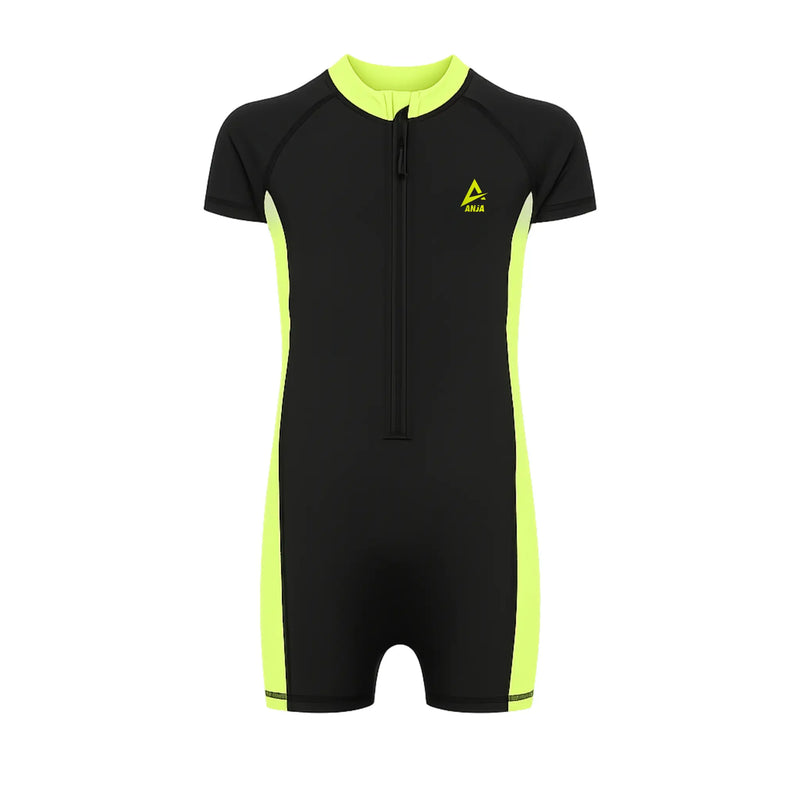
A pair of girls' sports leggings looks like one of the simplest things on a school kit list, and it is usually the first thing to fail. The waistband curls over after a month. The knees go pale and thin. The seam on the inner thigh starts to rub, and your daughter quietly stops wearing them — which means you buy again, and again, in the same school year.
This guide is written for parents in Egypt buying for girls aged 4 to 16: school PE twice a week, club training in the late afternoon, and a Cairo summer that does not care what the label promised. It covers how to judge stretch and recovery, how to read opacity before the first squat test, which leggings length fits which activity, and where Anja's leggings range fits each case. If you are starting a whole kit from scratch rather than replacing one item, read the broader girls' sportswear buying guide first and come back to this page for the bottoms.
Why Girls' Sports Leggings Wear Out Faster than Parents Expect
Leggings take more punishment than any other piece in a girl's kit. A top hangs off the shoulders. Leggings are stretched to roughly their working limit every single time they go on, then held there for two hours while she sits cross-legged on a gym floor, drags her knees along a mat, and sprints on a sandy school yard.
Three failures account for almost everything parents complain about. The first is lost recovery: the fabric still stretches, but it no longer snaps back, so the leggings bag at the knee and slide at the waist. The second is thinning at stress points — knees, seat, inner thigh — where the yarn abrades against surfaces and against itself. The third is not a fabric failure at all; it is a fit failure that was there on day one and only became obvious once she had to move in them.
The useful consequence is that you can predict most of a pair's life span in the first five minutes, at home, before the tags come off. That is what the next sections are for.
How to Judge Stretch Recovery before the First Wash
Stretch is easy to sell and easy to find. Recovery is the property that decides whether a pair survives a term. Do this with the leggings flat on a table.
- The four-way check. Pull the fabric across the width, then along the length. Both directions should give. Leggings that only stretch sideways will pull down at the waist every time she raises a knee.
- The snap-back count. Stretch a section of the thigh panel as far as it comfortably goes, hold for five seconds, release. It should return to its original shape immediately, with no wavy line left behind. A ripple that lingers is the pair that will bag at the knee by week three.
- The waistband roll test. Fold the waistband over on itself and let go. A good waistband lies flat again. One that stays folded will roll down on her all day, and no amount of washing fixes it.
- The seam stretch. Gently pull the fabric on either side of the inner-leg seam. The stitching should stretch with the fabric. If the seam stays rigid while the fabric moves, that seam is the point that will split.
- The cuff grip. At the ankle, the hem should hold shape without biting. A loose cuff rides up mid-sprint; a tight one leaves a mark after an hour.
A pair that passes all five is worth paying a little more for, because you are buying one pair instead of three. The Girls High-Waist Leggings are the pair I would hand a parent who wants one do-everything bottom: the high waistband is the part that keeps leggings where they belong through jumping, climbing and floor work, which is most of what a PE lesson actually consists of.
The Opacity Test That Prevents the Most Common Return
Opacity is the single most common reason a pair of girls' leggings gets worn once and then abandoned, and it is also the easiest thing to check. Thin leggings are not only a modesty problem; they are a confidence problem. A teenager who is not sure about her kit will not push herself in it.
Hold the leggings up to a window with daylight behind them, then do the same while stretching the seat and thigh panels to the width she would stretch them. Fabric that is opaque relaxed and sheer under tension is the trap. Then have her do one deep squat in front of a mirror at home. If the seat panel changes colour under stretch, the pair is not a training legging — it is a layering piece, and should be treated as one.
Darker, denser knits and panelled constructions hold up better under this test than flat pale fabrics. The Girls Black and White Sport Leggings are built around that logic, and they are a safer default for a girl who will be bending, stretching and sitting on the floor in front of a class. For girls or families who want more coverage without giving up movement, the Girls Tie-Waist Hip Cover layers over any legging, and the wider question of covered activewear is handled in the modest activewear guide for girls.
Legging Length and Cut: Full-Length, Wide-Leg and Shorts-Over-Leggings
Length is not a style decision in Egypt. It is a heat and surface decision. Full-length leggings protect knees on mats and gym floors and keep dust off the skin on an outdoor pitch, but they trap heat. Shorter cuts breathe but expose the knee. A wide-leg cut moves air but catches on equipment. Here is how the three realistic options compare for the way Egyptian girls actually train.
| Cut | Best for | Heat in a Cairo summer | Knee protection | Watch out for |
|---|---|---|---|---|
| Full-length fitted leggings | Gymnastics, indoor PE, floor work, winter training | Warmest — needs a light, breathable knit | Highest | Thin knees after a term of mat work |
| Wide-leg or flare leggings | Yoga, stretching, dance-style sessions, warm days | Coolest of the three — air moves up the leg | Low once the leg opens out | Hem catching on bars, pedals and equipment |
| Shorts layered over leggings | School PE where coverage is expected, athletics, team sport | Middle — two layers, but only on the hip | Depends on the legging underneath | Two layers to launder and match |
In practice, most girls need two of these rather than one. A fitted pair for club sessions and a cooler option for the hottest months is a better use of the same money than two identical pairs. The Girls Black Wide Leg Yoga Pants cover the second case, and the Girls Sporty Shorts with Leggings solve the school-PE coverage question in one garment instead of two. If she trains in heat and you want to compare pure shorts against leggings, the shorts collection and the wider girls' bottoms range sit side by side.
Fabric and Breathability for Cairo Heat and Afternoon Training
Cairo's problem is not only temperature. It is a long, hot afternoon training window followed by a cool evening, in dusty air. A legging that soaks through and stays wet is uncomfortable for the second half of the session and clammy on the way home.
What you want is a knit that moves moisture away from the skin and dries quickly, with enough elastic content to hold shape. What you want to avoid for real training is a heavy cotton-dominant legging: cotton absorbs sweat, holds it, gets heavier, and sags. Cotton is a fine choice for a school-run or after-training bottom, and a poor choice for a 4pm session in July. The full trade-off is laid out in the cotton versus Dri-Fit comparison, and it applies to leggings more sharply than to anything else because leggings sit against the skin over the whole leg.
One Egypt-specific detail worth knowing: dust. On an outdoor school yard, fine sand works into the knit and acts as an abrasive every time the fabric flexes. Shaking leggings out before they go in the machine does more for their life span than any fabric softener, and softener itself is best skipped entirely on stretch fabrics.
Sizing Girls' Leggings between Ages 4 and 16
Leggings are the one garment where buying a size up almost never works. A top can be roomy. Leggings that are too big slide down, bunch at the ankle and get rolled at the waist, which destroys the waistband within weeks. Size to her measurements now, and accept that bottoms are a more frequent replacement than tops.
Two measurements matter more than age: waist, and inside-leg length from crotch to ankle. Age ranges are a starting point, not an answer — a 10-year-old gymnast and a 10-year-old who has just had a growth spurt are not the same size. Measure once, write both numbers in your phone, and check them against the kids' sportswear size guide before each order.
For the 4–8 group, prioritise an easy pull-on waist she can manage herself in a changing room and knee durability for floor play. For 9–12, the fit question shifts to the waist staying put during jumping and running, which is where a high-rise cut earns its place. For 13–16, add opacity and comfort at the waistband to the list, because this is the age at which an uncomfortable or see-through pair simply stops being worn.
Matching Leggings to School PE, Club Training and Gymnastics
The same pair rarely serves every context, and the differences are worth knowing before you buy.
School PE. Two sessions a week, mixed surfaces, often a coverage expectation from the school. This is the case for a dark fitted legging or a shorts-over-legging combination, washed between sessions. Pair it with something from the girls' tops range that breathes, rather than a cotton school T-shirt.
Club training. Three to five sessions a week means you need two pairs minimum, simply so one can dry properly. This is where recovery quality pays for itself, and where the broader gym and training collection is the place to shop as a set rather than item by item.
Gymnastics. The most demanding case: constant floor contact, full range of movement, and a judged appearance. A smooth, dense, high-recovery legging with no bulky seams in the seat is the requirement, which is why the gymnastics collection exists separately, and why the Girls Metallic Gymnastics Set is sold as a coordinated piece.
A Pre-Purchase Checklist for Girls' Sports Leggings
Run this list before you pay, and again when the pair arrives, while a return is still possible.
- Does the fabric stretch in both directions and snap straight back?
- Does the waistband lie flat after being folded over, instead of staying rolled?
- Is the seat panel still opaque when it is stretched to the width she will stretch it?
- Are the inner-leg seams flat rather than raised, so they will not rub on a long session?
- Is the rise high enough to stay put through jumping and floor work?
- Does the ankle cuff hold without leaving a mark?
- Does the length suit the surface she trains on — mat, hall floor or sandy yard?
- Do you have a second pair, so one can air-dry fully between sessions?
- Did you size to her current waist and inside leg, not to a size up?
- Can she squat, sit cross-legged and raise a knee without adjusting anything?
If a pair fails the opacity or the waistband test, it is not a bargain at any price. Everything else on the list can be lived with; those two cannot.
How to Wash Girls' Leggings so They Keep Their Shape
Most leggings in Egypt die in the laundry rather than in training. Four habits extend their life more than anything else you can buy.
Turn them inside out and shake the dust out first. Wash cold, on a short cycle, with other soft items rather than with towels or zips. Skip fabric softener completely — it coats elastane and is a direct cause of lost recovery. And dry flat or on a line in the shade, never in direct Cairo sun and never over a hot radiator or in a dryer; heat is what finally kills the elastic. A pair washed this way after every session will outlast three pairs treated casually, and the whole girls' range responds the same way.
Frequently Asked Questions
What Age Range Does Anja Sportswear Cover for Girls' Leggings?
Anja makes kids' and teens' sportswear for ages 4 to 16 only. There is no adult range, so every legging on the site is cut and sized for a growing child rather than scaled down from an adult pattern.
How Many Pairs of Sports Leggings Does a Girl Need for a School Term?
For school PE alone, two pairs is enough: one in the bag, one drying. For club training three or more times a week, three pairs is the realistic number, because leggings need to dry fully between sessions and rushing them back on damp is what causes odour to set in.
Are Leggings Suitable for PE in a Cairo Summer, or Are Shorts Better?
Both work, and they solve different problems. Shorts are cooler; leggings protect the knees on mats and keep dust off the legs on an outdoor yard. A shorts-over-leggings piece is the usual compromise for schools that expect coverage, and a wide-leg cut is the coolest full-length option.
Should I Buy Girls' Leggings a Size up to Allow for Growth?
No. Leggings depend on fit to work: oversized pairs slide down, bunch at the ankle and get rolled at the waist, which ruins the waistband quickly. Measure her waist and inside leg and buy her current size, then replace when she outgrows it.
Why Do My Daughter's Leggings Go Baggy at the Knee?
That is lost recovery, usually caused by heat and fabric softener rather than by training. Washing cold without softener and drying flat in the shade prevents most of it. If a new pair already shows a lingering ripple after being stretched and released, the fabric itself has poor recovery and it will bag no matter how you wash it.